

'/%3E%3Cpath%20fill='%23b2b2b2'%20d='M241%20382q0%2016%2017%2026%2017%2011%2042%2011t42-11q16-11%2017-26V269H241'/%3E%3Cpath%20fill='%239f7e00'%20d='M241%20379q0%2014%208%2023%209%209%2021%209%2014%200%2021-9%209-9%209-23V269h-59'/%3E%3Cpath%20d='M241%20339v-70h59v110q0%2014-9%2023l-6%205v-68h-15v72q-8%200-14-4v-68zm59%2040c0%2022%2015%2032%2029%2032%2021%200%2030-18%2030-32v-40h-59'/%3E%3Cpath%20fill='%239f7e00'%20d='M266%20277v5h2v12h-3v-5h2v-5h-9v5h2v5h-4v9h3v18h-5v10h34v-10h-5v-18h3v-9h-4v-5h2v-5h-9v5h2v5h-3v-12h2v-5zm42%20101q0%2010%206%2017%206%206%2015%207%2010-1%2016-7%206-7%206-17v-29h-43'/%3E%3Ccircle%20fill='%230044ad'%20cx='329.5'%20cy='372'%20r='6'/%3E%3Cellipse%20fill='%230044ad'%20cx='300'%20cy='340'%20rx='16'%20ry='21'/%3E%3C/svg%3E)

The breaded products category in Brazil’s industry is experiencing a moment of consistent expansion, with growth sustained both by consumer demand and the evolution of industrial solutions.
According to Euromonitor data, the  processed and frozen chicken market currently generates approximately R$ 3.6 billion in revenue, with projections reaching R$ 7.7 billion by 2030. Within this scenario, breaded products represent 85% of the category, consolidating itself as one of the main engines of the segment.
This advance is not only explained by the volume, but by the category’s ability to adapt to new consumption dynamics. Breaded products are positioned today as a complete solution: it combines practicality, flavor and texture in a format that responds directly to the needs of everyday life.
This growth brings new challenges for the industry, especially in the development of products that can balance technical performance, consistency and sensory experience.
But what, in fact, is driving this evolution and how to transform these demands into more competitive products? This is what we explore next.
How is the breaded product market evolving in Brazil?
Analysis of the latest data shows a maturing category with continued growth and greater product diversity.
According to Euromonitor,  the market has evolved progressively over the years, with growth in value that accompanies the expansion of the portfolio and the incorporation of new attributes to the final product. In addition, the volume also grows steadily, with a CAGR of 2.6%, reinforcing the stability of consumption.
In the innovation segment, Mintel recorded 37 launches of breaded products in Brazil between January 2023 and December 2025, showing an active category under development. Among the main flavors identified, the following stand out:
- Traditional (56.8%)
- Spices (10.8%)
- Requeijão (5.4%)
- Onion (5.4%)
- Garlic (5.4%)
- Cumin (2.7%)
- Parsley (2.7%)
- Cheese (2.7%)
- Meat (2.7%)
- Oregano (2.7%)
Regarding the categories, the domain remains concentrated in animal proteins, with emphasis on:
- Fish (48.6%)
- Poultry (43.2%)
- Plant-based (5.4%)
- Meats (5.4%)
This scenario shows that, although the traditional base is still dominant, there is growing room for diversification, both in flavors and types of products.
What are the consumption directions in the breaded product category?
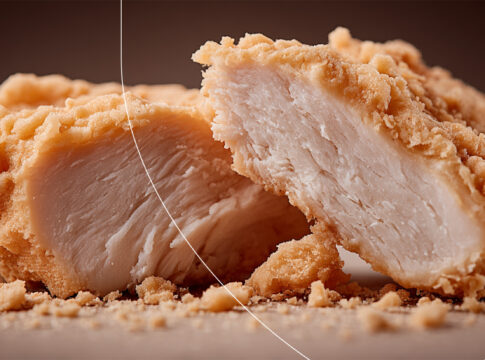
The evolution of the category is directly linked to changes in consumer behavior, which starts to value specific attributes in the choice of the product.
Convenience as the main driver
Practicality is consolidated as one of the main decision factors. According to Mintel, 38% of Brazilian consumers bought breaded meat products in 2024, reinforcing the category’s presence in everyday consumption.
In addition, the positioning data shows consumer preference:
- 37.8% highlight “easy to use”
- 13.5% emphasize oven or air fryer preparation
- 13.5% value speed
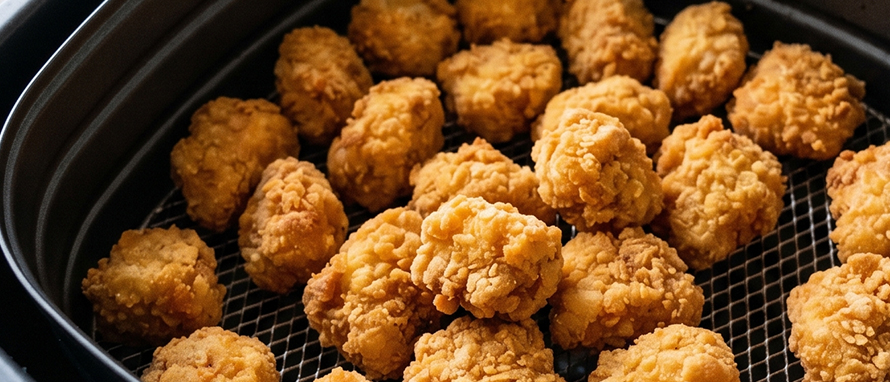
The popularization of the air fryer plays a central role in this movement, creating a new standard of preparation that combines convenience with the perception of healthiness and quality.
Portioning and expansion of consumption occasions
Smaller formats and products targeted at children are expanding consumption across different occasions, from quick meals to snacks and sharing occasions.
Indulgence and sensory experience
Breaded products are also positioned as indulgent products. The search for experiences closer to  food service is reflected in launches featuring intense flavors, enhanced crispiness, and profiles inspired by global trends.
Added value and differentiation
Consumers are not only looking for convenience and indulgence, but for a complete experience. This includes bold flavor, pleasant texture, and a perception of superior quality.
Innovation in product formats and proposals

We can clearly see these consumption trends in practice when looking at recent product launches, which show how the category has evolved beyond traditional breaded products.
Products developed for air fryer preparation are gaining traction by combining convenience, texture, and more indulgent sensory experiences. In the United Kingdom, Iceland launched breaded chicken strips inspired by Doritos Chilli Heatwave snacks, featuring a crispy coating and a more intense spicy profile. Designed for oven or air fryer preparation, the product reinforces the demand for bold flavors, pronounced crispiness, and experiences reminiscent of snack consumption and restaurant-style meals at home.
In Brazil, Seara introduced the classic Scotch egg, a launch that combines a boiled egg wrapped in ground meat and coated with a crispy breading, developed for quick preparation, including in air fryers. The concept combines practicality, convenience, and indulgence in a format that directly aligns with the growth of at-home consumption alongside the use of modern cooking appliances.
Partnerships and special editions are also continuing to expand the category’s perceived value. In collaboration with Netflix, Seara launched snacks such as Mini Korean Hot Dog and Popcorn Chicken, products coated in batter and inspired by international consumption trends. The line was developed for entertainment and casual consumption occasions, connecting food, pop culture, and shared experiences.
Perdigão, in turn, focused on emotional appeal by launching a special edition of heart-shaped mini chicken nuggets to celebrate the brand’s 90th anniversary. Beyond the unique format, the launch reinforces how breaded products are also exploring emotional connection, nostalgia, and innovative formats to create identification and engagement with consumers.
What are the technical challenges in developing breaded products?
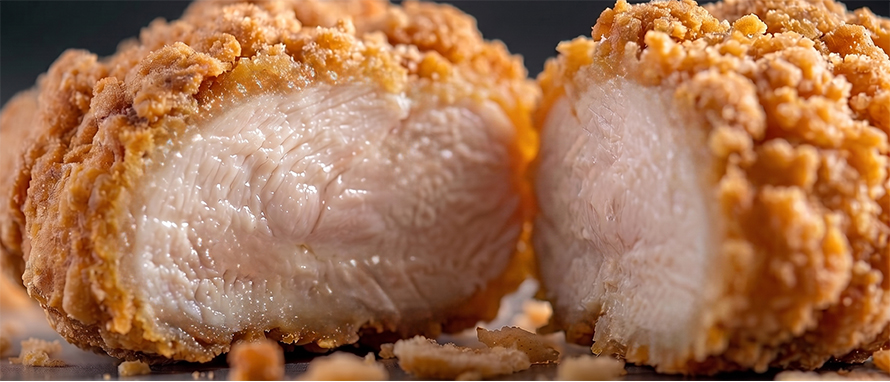
From an industrial standpoint, meeting today’s consumer demands requires breaded product development to overcome specific challenges that directly impact the product’s final quality. Among the main points are:
- Coating adhesion to the substrate
- Crispness maintenance after preparation
- Retention of internal juiciness
- Standardization
- Process yield and efficiency
These factors are directly linked to the consumer experience. The crispiness of the coating, the juiciness of the interior, and the balance of flavor influence the perception of quality and repeat purchase.
For this reason, breaded product development requires an integrated approach that considers both technical performance and the final sensory outcome.
How do DR Flavors & Ingredients’ solutions support breaded product development?
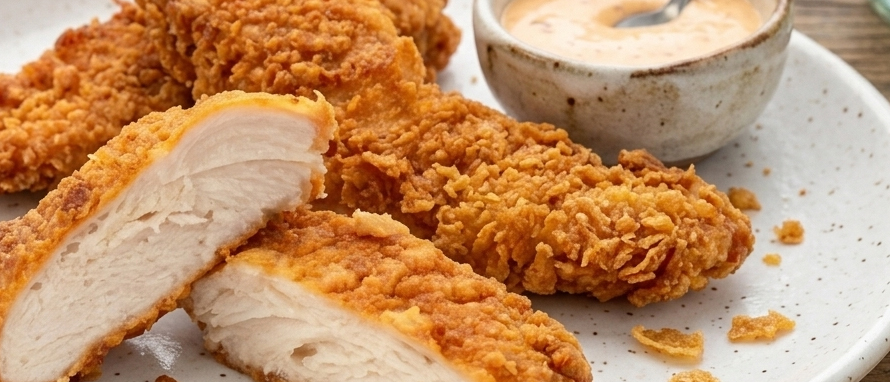
To support breaded product development, we have updated our complete category portfolio, integrating flavor, texture, and industrial performance in a way that is tailored to the industry’s needs.
Condiments: flavor that transforms
Our condiment combinations define the personality of breaded products by balancing aromatic notes, intensity, and authenticity, ensuring bold and distinctive flavor in every bite.
The category has been expanding the use of combinations inspired by different culinary references and sensory profiles, ranging from traditional flavors to bolder, spicy, smoky, and Asian-inspired offerings.
Profiles such as chipotle ranch, karaage, sweet chili, smoked paprika, and cheese-inspired combinations demonstrate how condiments contribute to expanding development possibilities within the category.
Beyond flavor, condiments influence aromatic perception and help shape the identity of the final product, contributing to differentiation, sensory consistency, and the market positioning of breaded products.
Additives for performance, stability and sensory quality
Additives play a fundamental role in the technical performance and stability of breaded products throughout the production process.
Flavor enhancers help intensify and balance the sensory profile of products, and can provide different characteristics, such as roasted, meaty, or smoky notes. Stabilizers and antioxidants, in turn, help retain moisture in the substrate, contributing to a pleasant texture and maintaining the juiciness of the final product.
Texture agents based on proteins and thickeners also contribute to the structure and firmness of the batter, especially in formed applications, supporting greater standardization and industrial performance.
These systems act directly in reducing process variations and quality control, contributing to greater sensory stability and consistency of the final product.
Liquid batter mix: adhesion, crunchiness and structure
Essential in the production of breaded products, batter is responsible for binding the substrate to the final coating.
Powdered preparations for batter formulation feature balanced formulas that facilitate the production process, ensuring proper miscibility and homogeneity of the powder in water, while also contributing to uniform coating, maintenance of substrate juiciness, and crispiness of the final coating.
The portfolio includes gluten-free options and solutions developed for different applications, including karaage-style coatings that deliver the crispiness and visual appeal characteristic of Asian cuisine.
The integration between condiments, breading systems, and functional solutions enables the development of more stable products, with greater process consistency and aligned with the category’s different product propositions.
Also read: 2026 food trends: what will drive innovation in the Food and Beverage Market
How can you make your product stand out in the market?
The growth of breaded products in the food industry reflects a combination of factors: convenience, versatility, and sensory evolution.
Market data shows a well-established category that is constantly evolving, with room for innovation in flavors, formats, and processing technologies.
In this scenario, product development requires an integrated approach, where flavor, texture, and industrial performance work in a complementary way.
At DR Flavors & Ingredients, we act as partners throughout this process, supporting the development of breaded products with distinctive sensory identity and high performance, connecting technical solutions to real market demands.
Exploring these possibilities means advancing the development of products that are more relevant to consumers and more efficient for the industry. Talk to us and let’s start developing together.